
Stablecoin Rails to Power Payouts in Emerging Markets: The CFO’s Guide to Global Disbursement
Stablecoin Rails to Power Payouts in Emerging Markets: The CFO’s Guide to Global Disbursement
Stablecoin Rails to Power Payouts in Emerging Markets: The CFO’s Guide to Global Disbursement
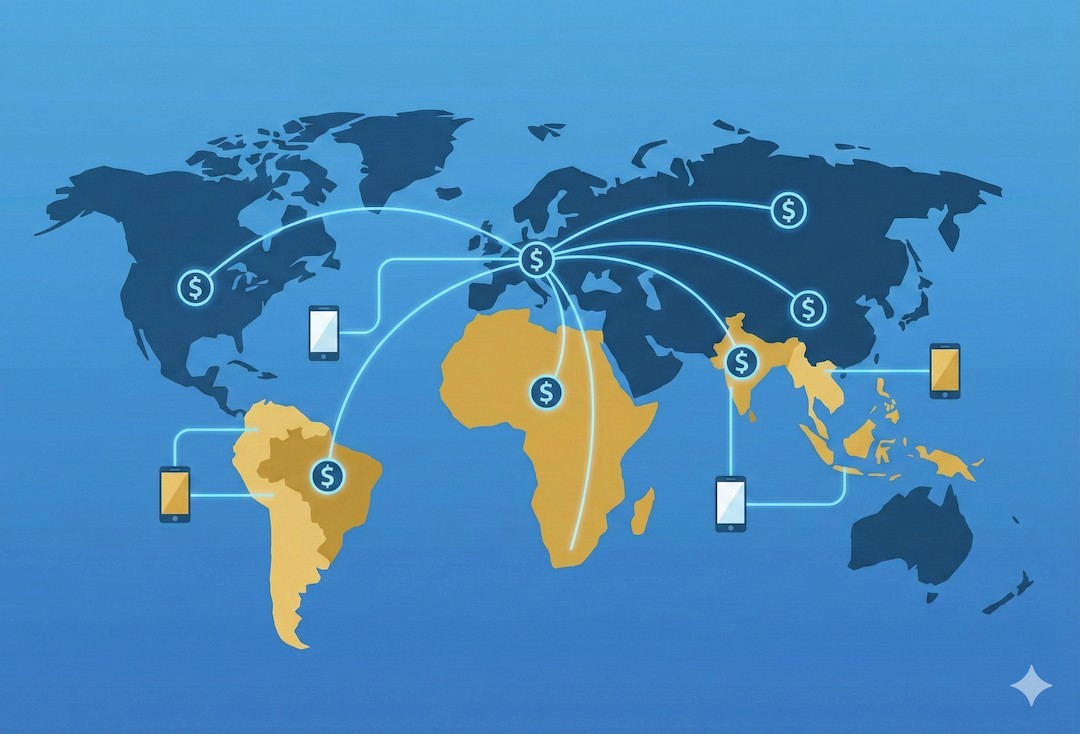
For multinational corporations, the "last mile" of money movement is often the most expensive.
While sending funds between London and New York is relatively seamless, the infrastructure breaks down when businesses attempt to scale operations into high-growth regions like Southeast Asia, Latin America, or Africa. Here, the legacy banking system is fragmented, slow, and exorbitantly expensive.
For CFOs and Treasurers, this is not just an operational headache; it is a drag on liquidity.
The solution shifting the landscape is the use of stablecoin rails to power payouts in emerging markets. By bypassing the correspondent banking network entirely, businesses can achieve T+0 settlement (instant finality) while reducing transaction costs by margins that were previously impossible.
This guide explores why financial institutions and forward-thinking enterprises are migrating from SWIFT messaging to blockchain settlement.
What You Will Learn
The Infrastructure Shift: A deep dive into the mechanics of "stablecoin rails" versus legacy banking.
The Damisa Model: How to utilise these rails without your finance team needing to manage private keys or volatile crypto.
The Economics: How cutting the "Intermediary Tax" saves 3–7% per transaction.
Strategic Use Cases: Managing mass payouts for gig workers and eliminating demurrage costs in supply chains.
The Failure of Legacy Rails in Emerging Markets
To understand why stablecoin rails to power payouts in emerging markets are necessary, one must first audit the failure of the current system.
When a European company sends funds to a contractor in Nigeria or a supplier in Brazil via SWIFT, the money does not travel directly. It hops through a chain of correspondent banks. Each bank charges a lifting fee, requires compliance checks, and adds a time delay.
In emerging markets, this results in two critical failures:
Liquidity Traps and Dollar Shortages
Local banks in high-growth regions often face US Dollar shortages. Even if the transfer arrives, the recipient bank may not have the physical currency to honour the withdrawal immediately. This creates a bottleneck where capital is theoretically "there" but practically inaccessible.
The "Intermediary Tax"
As we detailed in our guide Reduce SWIFT Fees: The B2B Guide to Stopping the "Intermediary Tax", businesses often lose 3–7% of the total transaction value to FX markups and wire fees. This is a friction cost that scales linearly with your growth, effectively penalising success.
Deep Dive: What Are Stablecoin Rails?
The term "rails" is often used in fintech, but it is rarely explained clearly.
Think of payment rails as the physical tracks a train runs on. In the traditional world, the "tracks" are the SWIFT network—a messaging system that tells banks to move money. It is old (established in the 1970s), operates only during banking hours, and relies on manual reconciliation.
Stablecoin rails are the modern alternative. They use open, 24/7 blockchain networks (like Ethereum, Solana, or Polygon) to transmit value.
How The Architecture Differs
The Asset (The Train): Instead of a digital promise of fiat, we use a Fiat-Backed Stablecoin (like USDC or USDT). These are digital tokens fully reserved 1:1 with the US dollar. For a technical breakdown, read What is a Fiat-Backed Stablecoin? The CFO’s Guide to Instant B2B Settlement.
The Network (The Track): The blockchain allows for peer-to-peer transfer. There are no correspondent banks in the middle. The money moves from Wallet A to Wallet B programmatically.
The Settlement (The Arrival): SWIFT offers T+2 to T+5 settlement (days). Stablecoin rails offer Atomic Settlement—meaning the payment is cleared and settled simultaneously, usually in seconds.
Comparison: Legacy vs. Stablecoin Rails
Feature | SWIFT (Legacy Rails) | Stablecoin Rails |
Operating Hours | Mon-Fri (Banking Hours) | 24/7/365 |
Intermediaries | 2–4 Correspondent Banks | None (Peer-to-Peer) |
Speed | 2–5 Business Days | Minutes / Seconds |
Transparency | Opaque (Black Box) | Public Ledger (Traceable) |
Cost | High ($15–$50 + FX Spread) | Low (Gas fees + <1% spread) |
How Damisa Facilitates the Flow (Without the Crypto Risk)
A common hesitation for CFOs is the perceived complexity of handling cryptocurrency. This is where Damisa acts as the critical bridge.
We act as the payment facilitator, allowing you to utilise stablecoin rails to power payouts in emerging markets without exposing your treasury to volatility or technical complexity.
The Damisa Workflow
Funding: You fund your Damisa account in your local fiat currency (GBP, EUR, USD).
Conversion: We instantly tokenise this capital into stablecoins (e.g., USDC).
Transmission: The funds travel over the stablecoin rails—bypassing the slow banking network.
Off-Ramp: We utilise our network of local liquidity providers in the destination country (e.g., Nigeria, Brazil, Philippines).
Payout: The recipient receives the funds in their preferred format—either local fiat currency directly into their bank account, or stablecoins if they prefer to hold USD equivalents.
By handling the "heavy lifting" of the blockchain interaction, Damisa ensures you remain compliant. We adhere to strict KYC and AML standards, answering the vital 10 Questions to Ask When Vetting a Stablecoin Payments Partner.
Strategic Use Cases for Modern Enterprises
The application of this technology extends beyond simple transfers. It fundamentally changes how businesses manage global treasury.
Global Payroll and Gig Economy Disbursements
Managing payroll for remote teams in Argentina, Kenya, or the Philippines is notoriously difficult due to currency volatility. By using stablecoin rails, businesses ensure workers receive the full value of their wages instantly.
This is particularly vital in high-inflation economies where a 3-day banking delay can result in a loss of purchasing power for the recipient. For a deeper dive into the importance of financial inclusion, read LATAM and Africa Don’t Need Banks. They Need Access.
Supply Chain and Supplier Settlement
For logistics and manufacturing, payment speed equates to supply chain speed. If you are Paying Overseas Suppliers with Stablecoins, you eliminate the wait times that cause goods to sit in ports.
This direct injection of liquidity is a financial strategy often overlooked by supply chain directors. It helps companies Reduce Demurrage Costs by ensuring cargo is released immediately upon payment arrival, rather than waiting for a SWIFT confirmation.
Automating Finance with Smart Contracts
Beyond speed, stablecoin rails enable automation. Using Smart Contracts for Commodity Trading, you can automate payments based on specific triggers—such as a confirmed delivery or a completed work cycle. This removes manual administrative work and reduces human error.
Case Study: The Global Gig Platform
The Scenario: 'TalentConnect' (a fictional entity) connects UK businesses with freelance developers in Nigeria and Brazil. They need to pay out $200,000 monthly to 400 distinct freelancers.
The Old Way (Aggregators & Banks):
Fees: 3% FX markup + $15 per transfer.
Time: Freelancers wait 5 business days to see funds.
Failure Rate: 4% of transactions fail due to incorrect banking codes.
The Damisa Way (Stablecoin Rails):
TalentConnect funds their Damisa business account. They execute a bulk payout using stablecoin rails.
Fees: Minimal transaction gas fees and a fixed low percentage. They effectively Cut Costs by 80% on Cross-Border Business Payments.
Time: Freelancers receive funds in their digital wallets in T+0 (minutes).
Result: TalentConnect reduces operational spend by over $5,000 per month and improves freelancer retention.
Navigating the Token Landscape
Not all digital assets are suitable for B2B payouts. A common question we encounter is which asset to use.
CFOs must distinguish between speculative cryptocurrencies and settlement instruments. We generally advocate for fully reserved, fiat-backed assets. However, liquidity varies by region.
USDT (Tether): Often has higher liquidity in Asian and African street markets.
USDC (Circle): Often preferred by regulated US/EU institutions for its transparency.
Choosing the right instrument is critical for minimising slippage. We break down this decision-making process in our article: USDC vs USDT for Business: The CFO’s Guide to Safer Settlements.
Frequently Asked Questions
Is using stablecoin rails compliant for B2B payouts?
Yes, provided you work with a regulated partner.
Damisa adheres to strict KYC (Know Your Customer) and AML (Anti-Money Laundering) standards. The transaction is treated as a digital asset transfer, which is legal in the vast majority of jurisdictions.
Do my recipients need to be "crypto-savvy"?
Not necessarily.
While the settlement happens on stablecoin rails, the end-user experience can be tailored. However, many businesses in emerging markets actually prefer receiving stablecoins because they act as a hedge against their local currency's inflation.
How does this impact my treasury's volatility risk?
It eliminates it.
Unlike Bitcoin, stablecoins are pegged to the dollar. You send $1, the recipient gets $1. If you are worried about holding assets, we recommend reading The Pros and Cons of B2B Cryptocurrency Payments: A CFO’s Guide to Stablecoin Settlement.
Can I automate these payouts?
Yes. This is one of the strongest features of the technology. By utilizing Programmable Wallets, you can automate recurring payments and replace outdated manual processes like Letters of Credit.
Conclusion
The ability to move capital efficiently is no longer just a backend function; it is a competitive wedge.
Businesses that continue to rely on legacy banking for payouts in emerging markets are effectively paying a voluntary tax on their growth—in both fees and time. The data is clear: stablecoin rails to power payouts in emerging markets offer a superior infrastructure for the modern global economy.
Whether you are paying a developer in Lagos, a supplier in São Paulo, or a logistics partner in Shanghai, the rails you choose determine the speed of your business.
Ready to modernise your global disbursements?
Stop letting legacy banks slow down your operations.
For multinational corporations, the "last mile" of money movement is often the most expensive.
While sending funds between London and New York is relatively seamless, the infrastructure breaks down when businesses attempt to scale operations into high-growth regions like Southeast Asia, Latin America, or Africa. Here, the legacy banking system is fragmented, slow, and exorbitantly expensive.
For CFOs and Treasurers, this is not just an operational headache; it is a drag on liquidity.
The solution shifting the landscape is the use of stablecoin rails to power payouts in emerging markets. By bypassing the correspondent banking network entirely, businesses can achieve T+0 settlement (instant finality) while reducing transaction costs by margins that were previously impossible.
This guide explores why financial institutions and forward-thinking enterprises are migrating from SWIFT messaging to blockchain settlement.
What You Will Learn
The Infrastructure Shift: A deep dive into the mechanics of "stablecoin rails" versus legacy banking.
The Damisa Model: How to utilise these rails without your finance team needing to manage private keys or volatile crypto.
The Economics: How cutting the "Intermediary Tax" saves 3–7% per transaction.
Strategic Use Cases: Managing mass payouts for gig workers and eliminating demurrage costs in supply chains.
The Failure of Legacy Rails in Emerging Markets
To understand why stablecoin rails to power payouts in emerging markets are necessary, one must first audit the failure of the current system.
When a European company sends funds to a contractor in Nigeria or a supplier in Brazil via SWIFT, the money does not travel directly. It hops through a chain of correspondent banks. Each bank charges a lifting fee, requires compliance checks, and adds a time delay.
In emerging markets, this results in two critical failures:
Liquidity Traps and Dollar Shortages
Local banks in high-growth regions often face US Dollar shortages. Even if the transfer arrives, the recipient bank may not have the physical currency to honour the withdrawal immediately. This creates a bottleneck where capital is theoretically "there" but practically inaccessible.
The "Intermediary Tax"
As we detailed in our guide Reduce SWIFT Fees: The B2B Guide to Stopping the "Intermediary Tax", businesses often lose 3–7% of the total transaction value to FX markups and wire fees. This is a friction cost that scales linearly with your growth, effectively penalising success.
Deep Dive: What Are Stablecoin Rails?
The term "rails" is often used in fintech, but it is rarely explained clearly.
Think of payment rails as the physical tracks a train runs on. In the traditional world, the "tracks" are the SWIFT network—a messaging system that tells banks to move money. It is old (established in the 1970s), operates only during banking hours, and relies on manual reconciliation.
Stablecoin rails are the modern alternative. They use open, 24/7 blockchain networks (like Ethereum, Solana, or Polygon) to transmit value.
How The Architecture Differs
The Asset (The Train): Instead of a digital promise of fiat, we use a Fiat-Backed Stablecoin (like USDC or USDT). These are digital tokens fully reserved 1:1 with the US dollar. For a technical breakdown, read What is a Fiat-Backed Stablecoin? The CFO’s Guide to Instant B2B Settlement.
The Network (The Track): The blockchain allows for peer-to-peer transfer. There are no correspondent banks in the middle. The money moves from Wallet A to Wallet B programmatically.
The Settlement (The Arrival): SWIFT offers T+2 to T+5 settlement (days). Stablecoin rails offer Atomic Settlement—meaning the payment is cleared and settled simultaneously, usually in seconds.
Comparison: Legacy vs. Stablecoin Rails
Feature | SWIFT (Legacy Rails) | Stablecoin Rails |
Operating Hours | Mon-Fri (Banking Hours) | 24/7/365 |
Intermediaries | 2–4 Correspondent Banks | None (Peer-to-Peer) |
Speed | 2–5 Business Days | Minutes / Seconds |
Transparency | Opaque (Black Box) | Public Ledger (Traceable) |
Cost | High ($15–$50 + FX Spread) | Low (Gas fees + <1% spread) |
How Damisa Facilitates the Flow (Without the Crypto Risk)
A common hesitation for CFOs is the perceived complexity of handling cryptocurrency. This is where Damisa acts as the critical bridge.
We act as the payment facilitator, allowing you to utilise stablecoin rails to power payouts in emerging markets without exposing your treasury to volatility or technical complexity.
The Damisa Workflow
Funding: You fund your Damisa account in your local fiat currency (GBP, EUR, USD).
Conversion: We instantly tokenise this capital into stablecoins (e.g., USDC).
Transmission: The funds travel over the stablecoin rails—bypassing the slow banking network.
Off-Ramp: We utilise our network of local liquidity providers in the destination country (e.g., Nigeria, Brazil, Philippines).
Payout: The recipient receives the funds in their preferred format—either local fiat currency directly into their bank account, or stablecoins if they prefer to hold USD equivalents.
By handling the "heavy lifting" of the blockchain interaction, Damisa ensures you remain compliant. We adhere to strict KYC and AML standards, answering the vital 10 Questions to Ask When Vetting a Stablecoin Payments Partner.
Strategic Use Cases for Modern Enterprises
The application of this technology extends beyond simple transfers. It fundamentally changes how businesses manage global treasury.
Global Payroll and Gig Economy Disbursements
Managing payroll for remote teams in Argentina, Kenya, or the Philippines is notoriously difficult due to currency volatility. By using stablecoin rails, businesses ensure workers receive the full value of their wages instantly.
This is particularly vital in high-inflation economies where a 3-day banking delay can result in a loss of purchasing power for the recipient. For a deeper dive into the importance of financial inclusion, read LATAM and Africa Don’t Need Banks. They Need Access.
Supply Chain and Supplier Settlement
For logistics and manufacturing, payment speed equates to supply chain speed. If you are Paying Overseas Suppliers with Stablecoins, you eliminate the wait times that cause goods to sit in ports.
This direct injection of liquidity is a financial strategy often overlooked by supply chain directors. It helps companies Reduce Demurrage Costs by ensuring cargo is released immediately upon payment arrival, rather than waiting for a SWIFT confirmation.
Automating Finance with Smart Contracts
Beyond speed, stablecoin rails enable automation. Using Smart Contracts for Commodity Trading, you can automate payments based on specific triggers—such as a confirmed delivery or a completed work cycle. This removes manual administrative work and reduces human error.
Case Study: The Global Gig Platform
The Scenario: 'TalentConnect' (a fictional entity) connects UK businesses with freelance developers in Nigeria and Brazil. They need to pay out $200,000 monthly to 400 distinct freelancers.
The Old Way (Aggregators & Banks):
Fees: 3% FX markup + $15 per transfer.
Time: Freelancers wait 5 business days to see funds.
Failure Rate: 4% of transactions fail due to incorrect banking codes.
The Damisa Way (Stablecoin Rails):
TalentConnect funds their Damisa business account. They execute a bulk payout using stablecoin rails.
Fees: Minimal transaction gas fees and a fixed low percentage. They effectively Cut Costs by 80% on Cross-Border Business Payments.
Time: Freelancers receive funds in their digital wallets in T+0 (minutes).
Result: TalentConnect reduces operational spend by over $5,000 per month and improves freelancer retention.
Navigating the Token Landscape
Not all digital assets are suitable for B2B payouts. A common question we encounter is which asset to use.
CFOs must distinguish between speculative cryptocurrencies and settlement instruments. We generally advocate for fully reserved, fiat-backed assets. However, liquidity varies by region.
USDT (Tether): Often has higher liquidity in Asian and African street markets.
USDC (Circle): Often preferred by regulated US/EU institutions for its transparency.
Choosing the right instrument is critical for minimising slippage. We break down this decision-making process in our article: USDC vs USDT for Business: The CFO’s Guide to Safer Settlements.
Frequently Asked Questions
Is using stablecoin rails compliant for B2B payouts?
Yes, provided you work with a regulated partner.
Damisa adheres to strict KYC (Know Your Customer) and AML (Anti-Money Laundering) standards. The transaction is treated as a digital asset transfer, which is legal in the vast majority of jurisdictions.
Do my recipients need to be "crypto-savvy"?
Not necessarily.
While the settlement happens on stablecoin rails, the end-user experience can be tailored. However, many businesses in emerging markets actually prefer receiving stablecoins because they act as a hedge against their local currency's inflation.
How does this impact my treasury's volatility risk?
It eliminates it.
Unlike Bitcoin, stablecoins are pegged to the dollar. You send $1, the recipient gets $1. If you are worried about holding assets, we recommend reading The Pros and Cons of B2B Cryptocurrency Payments: A CFO’s Guide to Stablecoin Settlement.
Can I automate these payouts?
Yes. This is one of the strongest features of the technology. By utilizing Programmable Wallets, you can automate recurring payments and replace outdated manual processes like Letters of Credit.
Conclusion
The ability to move capital efficiently is no longer just a backend function; it is a competitive wedge.
Businesses that continue to rely on legacy banking for payouts in emerging markets are effectively paying a voluntary tax on their growth—in both fees and time. The data is clear: stablecoin rails to power payouts in emerging markets offer a superior infrastructure for the modern global economy.
Whether you are paying a developer in Lagos, a supplier in São Paulo, or a logistics partner in Shanghai, the rails you choose determine the speed of your business.
Ready to modernise your global disbursements?
Stop letting legacy banks slow down your operations.
For multinational corporations, the "last mile" of money movement is often the most expensive.
While sending funds between London and New York is relatively seamless, the infrastructure breaks down when businesses attempt to scale operations into high-growth regions like Southeast Asia, Latin America, or Africa. Here, the legacy banking system is fragmented, slow, and exorbitantly expensive.
For CFOs and Treasurers, this is not just an operational headache; it is a drag on liquidity.
The solution shifting the landscape is the use of stablecoin rails to power payouts in emerging markets. By bypassing the correspondent banking network entirely, businesses can achieve T+0 settlement (instant finality) while reducing transaction costs by margins that were previously impossible.
This guide explores why financial institutions and forward-thinking enterprises are migrating from SWIFT messaging to blockchain settlement.
What You Will Learn
The Infrastructure Shift: A deep dive into the mechanics of "stablecoin rails" versus legacy banking.
The Damisa Model: How to utilise these rails without your finance team needing to manage private keys or volatile crypto.
The Economics: How cutting the "Intermediary Tax" saves 3–7% per transaction.
Strategic Use Cases: Managing mass payouts for gig workers and eliminating demurrage costs in supply chains.
The Failure of Legacy Rails in Emerging Markets
To understand why stablecoin rails to power payouts in emerging markets are necessary, one must first audit the failure of the current system.
When a European company sends funds to a contractor in Nigeria or a supplier in Brazil via SWIFT, the money does not travel directly. It hops through a chain of correspondent banks. Each bank charges a lifting fee, requires compliance checks, and adds a time delay.
In emerging markets, this results in two critical failures:
Liquidity Traps and Dollar Shortages
Local banks in high-growth regions often face US Dollar shortages. Even if the transfer arrives, the recipient bank may not have the physical currency to honour the withdrawal immediately. This creates a bottleneck where capital is theoretically "there" but practically inaccessible.
The "Intermediary Tax"
As we detailed in our guide Reduce SWIFT Fees: The B2B Guide to Stopping the "Intermediary Tax", businesses often lose 3–7% of the total transaction value to FX markups and wire fees. This is a friction cost that scales linearly with your growth, effectively penalising success.
Deep Dive: What Are Stablecoin Rails?
The term "rails" is often used in fintech, but it is rarely explained clearly.
Think of payment rails as the physical tracks a train runs on. In the traditional world, the "tracks" are the SWIFT network—a messaging system that tells banks to move money. It is old (established in the 1970s), operates only during banking hours, and relies on manual reconciliation.
Stablecoin rails are the modern alternative. They use open, 24/7 blockchain networks (like Ethereum, Solana, or Polygon) to transmit value.
How The Architecture Differs
The Asset (The Train): Instead of a digital promise of fiat, we use a Fiat-Backed Stablecoin (like USDC or USDT). These are digital tokens fully reserved 1:1 with the US dollar. For a technical breakdown, read What is a Fiat-Backed Stablecoin? The CFO’s Guide to Instant B2B Settlement.
The Network (The Track): The blockchain allows for peer-to-peer transfer. There are no correspondent banks in the middle. The money moves from Wallet A to Wallet B programmatically.
The Settlement (The Arrival): SWIFT offers T+2 to T+5 settlement (days). Stablecoin rails offer Atomic Settlement—meaning the payment is cleared and settled simultaneously, usually in seconds.
Comparison: Legacy vs. Stablecoin Rails
Feature | SWIFT (Legacy Rails) | Stablecoin Rails |
Operating Hours | Mon-Fri (Banking Hours) | 24/7/365 |
Intermediaries | 2–4 Correspondent Banks | None (Peer-to-Peer) |
Speed | 2–5 Business Days | Minutes / Seconds |
Transparency | Opaque (Black Box) | Public Ledger (Traceable) |
Cost | High ($15–$50 + FX Spread) | Low (Gas fees + <1% spread) |
How Damisa Facilitates the Flow (Without the Crypto Risk)
A common hesitation for CFOs is the perceived complexity of handling cryptocurrency. This is where Damisa acts as the critical bridge.
We act as the payment facilitator, allowing you to utilise stablecoin rails to power payouts in emerging markets without exposing your treasury to volatility or technical complexity.
The Damisa Workflow
Funding: You fund your Damisa account in your local fiat currency (GBP, EUR, USD).
Conversion: We instantly tokenise this capital into stablecoins (e.g., USDC).
Transmission: The funds travel over the stablecoin rails—bypassing the slow banking network.
Off-Ramp: We utilise our network of local liquidity providers in the destination country (e.g., Nigeria, Brazil, Philippines).
Payout: The recipient receives the funds in their preferred format—either local fiat currency directly into their bank account, or stablecoins if they prefer to hold USD equivalents.
By handling the "heavy lifting" of the blockchain interaction, Damisa ensures you remain compliant. We adhere to strict KYC and AML standards, answering the vital 10 Questions to Ask When Vetting a Stablecoin Payments Partner.
Strategic Use Cases for Modern Enterprises
The application of this technology extends beyond simple transfers. It fundamentally changes how businesses manage global treasury.
Global Payroll and Gig Economy Disbursements
Managing payroll for remote teams in Argentina, Kenya, or the Philippines is notoriously difficult due to currency volatility. By using stablecoin rails, businesses ensure workers receive the full value of their wages instantly.
This is particularly vital in high-inflation economies where a 3-day banking delay can result in a loss of purchasing power for the recipient. For a deeper dive into the importance of financial inclusion, read LATAM and Africa Don’t Need Banks. They Need Access.
Supply Chain and Supplier Settlement
For logistics and manufacturing, payment speed equates to supply chain speed. If you are Paying Overseas Suppliers with Stablecoins, you eliminate the wait times that cause goods to sit in ports.
This direct injection of liquidity is a financial strategy often overlooked by supply chain directors. It helps companies Reduce Demurrage Costs by ensuring cargo is released immediately upon payment arrival, rather than waiting for a SWIFT confirmation.
Automating Finance with Smart Contracts
Beyond speed, stablecoin rails enable automation. Using Smart Contracts for Commodity Trading, you can automate payments based on specific triggers—such as a confirmed delivery or a completed work cycle. This removes manual administrative work and reduces human error.
Case Study: The Global Gig Platform
The Scenario: 'TalentConnect' (a fictional entity) connects UK businesses with freelance developers in Nigeria and Brazil. They need to pay out $200,000 monthly to 400 distinct freelancers.
The Old Way (Aggregators & Banks):
Fees: 3% FX markup + $15 per transfer.
Time: Freelancers wait 5 business days to see funds.
Failure Rate: 4% of transactions fail due to incorrect banking codes.
The Damisa Way (Stablecoin Rails):
TalentConnect funds their Damisa business account. They execute a bulk payout using stablecoin rails.
Fees: Minimal transaction gas fees and a fixed low percentage. They effectively Cut Costs by 80% on Cross-Border Business Payments.
Time: Freelancers receive funds in their digital wallets in T+0 (minutes).
Result: TalentConnect reduces operational spend by over $5,000 per month and improves freelancer retention.
Navigating the Token Landscape
Not all digital assets are suitable for B2B payouts. A common question we encounter is which asset to use.
CFOs must distinguish between speculative cryptocurrencies and settlement instruments. We generally advocate for fully reserved, fiat-backed assets. However, liquidity varies by region.
USDT (Tether): Often has higher liquidity in Asian and African street markets.
USDC (Circle): Often preferred by regulated US/EU institutions for its transparency.
Choosing the right instrument is critical for minimising slippage. We break down this decision-making process in our article: USDC vs USDT for Business: The CFO’s Guide to Safer Settlements.
Frequently Asked Questions
Is using stablecoin rails compliant for B2B payouts?
Yes, provided you work with a regulated partner.
Damisa adheres to strict KYC (Know Your Customer) and AML (Anti-Money Laundering) standards. The transaction is treated as a digital asset transfer, which is legal in the vast majority of jurisdictions.
Do my recipients need to be "crypto-savvy"?
Not necessarily.
While the settlement happens on stablecoin rails, the end-user experience can be tailored. However, many businesses in emerging markets actually prefer receiving stablecoins because they act as a hedge against their local currency's inflation.
How does this impact my treasury's volatility risk?
It eliminates it.
Unlike Bitcoin, stablecoins are pegged to the dollar. You send $1, the recipient gets $1. If you are worried about holding assets, we recommend reading The Pros and Cons of B2B Cryptocurrency Payments: A CFO’s Guide to Stablecoin Settlement.
Can I automate these payouts?
Yes. This is one of the strongest features of the technology. By utilizing Programmable Wallets, you can automate recurring payments and replace outdated manual processes like Letters of Credit.
Conclusion
The ability to move capital efficiently is no longer just a backend function; it is a competitive wedge.
Businesses that continue to rely on legacy banking for payouts in emerging markets are effectively paying a voluntary tax on their growth—in both fees and time. The data is clear: stablecoin rails to power payouts in emerging markets offer a superior infrastructure for the modern global economy.
Whether you are paying a developer in Lagos, a supplier in São Paulo, or a logistics partner in Shanghai, the rails you choose determine the speed of your business.
Ready to modernise your global disbursements?
Stop letting legacy banks slow down your operations.
Category
News
Insights
Date Published
Jan 20, 2026
Written by

Damisaverse
Category
News
Insights
Date Published
Jan 20, 2026
Written by
Damisaverse
Category
News
Insights
Date Published
Jan 20, 2026
Written by
Damisaverse
Blog and articles
Latest insights and trends
Blog and articles
Latest insights and trends
Blog and articles
Latest insights and trends






Ready to elevate your business?

Easily adapt to changes and scale your operations with our flexible infrastructure, designed to support your business growth.
© 2026 Damisa Technologies. All rights reserved.
Ready to elevate your business?
Easily adapt to changes and scale your operations with our flexible infrastructure, designed to support your business growth.
© 2026 Damisa Technologies. All rights reserved.
Ready to elevate your business?
Easily adapt to changes and scale your operations with our flexible infrastructure, designed to support your business growth.
© 2026 Damisa Technologies. All rights reserved.